

State Bridge Section News
State Bridge Section News Archive
Questions may be directed to the State Bridge Design Engineer, Phone: (785) 296-3761 or to the contact listed in each news item.
Amended 9/5/13: Abutment Aggregate Drainage System
Added 09/05/2013 Contact: Bridge Design Manuals, Modeling and Policy Engineer. Phone: 785-368-7175The geofoam dimension on the “Abutment Aggregate Drain” has changed from 2’-6” to 1’-6” to allow the first guardrail post to be driven well into the aggregate behind the geofoam. Please down load the current Base Sheet(s) or revise accordingly.
Beginning with the September 2012 Lettings, KDOT will begin using a redesigned abutment drainage system. The Abutment Strip Drains used in the past will be phased out, for projects on the State Highway System, in lieu of Abutment Aggregate Drains. Begin using as soon as possible. For projects on the Local System consult the Bureau of Local Projects. Abutment strip drains can still be used for all three span and single span RCSH bridges. Consult with KDOT district personnel on preference when both strip drains and aggregate drains can be used.
The new Base Sheets are BR 104 aa thru BR104 hh and are available on KART for Consultant designs and WebStd for in-house designs. These Base Sheets have changed details, bid item, and general notes. Use the bid item “Abutment Aggregate Drains” in units of Cubic Yards for the “Summary of Quantities and General Notes”. There are several new subsidiary items to calculate (for information only). Special Provisions 07-07026 (Abutment Drainage System), the use of 07-2005 (Geofoam), and Sections 1710 (Geosynthetics)(Base Coarse Reinforcement) are the result of this change. Please review the special provisions and general notes prior to use.
The new design offers advantages of stabilized and reinforced aggregate backfill for drainage, improved control of fines migration and pressure relief from axial forces due to longitudinal movements.
The existing “Abutment Strip Drain” Base Sheets will continue to be available. (See above acceptable uses)
Membrane Sealant Gap Table
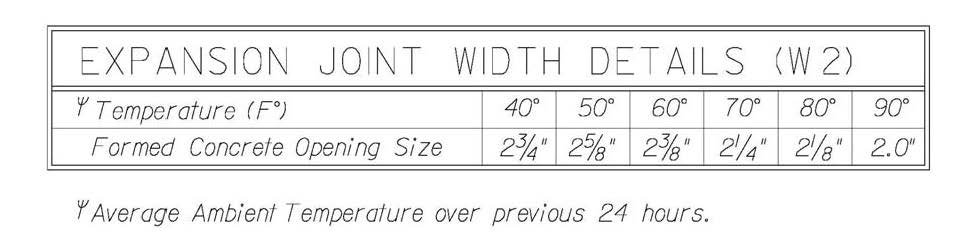
Added 06/25/2013 Contact: Bridge Design Manuals, Modeling and Policy Engineer. Phone: 785-368-7175The Road Standard RD712 “Bridge Approach Slab Details” and all other Road Approach Slab Sheets now directs the Contractor to look at the Bridge “Construction Layout Sheet” for the approach slab joint gap table. The Bridge Design Manual and the Road Standards now reflect this method of sizing the joint opening based on the bridge expansion length. This is similar to what has been done in the past and we are going back to this method. The gap tables for temperature vs. bridge expansion length can be found in Section 3.14 “Joints and Bearings” pg. 3-14-4. The designer will place a table for the bridge expansion length for temperatures of 40 to 90 degrees by creating a table of gap values, for the formed concrete opening, on the “Bridge Construction Layout” sheet.
A cell has been created in the Cell Library named "Gap Table" which can be used for this purpose.
Example: Use 200’ of expansion length from the steel table to create the gap table below.
2013 KDOT LFD Bridge Design Manual
Added 2/21/2013 Contact: Bridge Design Manuals, Modeling and Policy Engineer. Phone: 785-368-7175The 2013 version of the KDOT LFD Bridge Design Manual is available for download. This manual supersedes all previous versions in their entirety. Please review the revisions.
The updated Bridge Design Manual is located on: KART
LRFD Bridge Design Manual
Added 12/11/2012 Contact: Bridge Design Manuals, Modeling and Policy Engineer. Phone: 785-368-7175KDOT has added a section to the LRFD KDOT Bridge Design Manual, Section 3.6 ”Steel Structures”. Please refer to this section as it supersedes the 2012 LFD Bridge Design Manual section.
Manual is available for use at: http://www.ksdot.org/burDesign/bridge/lrfd/bdlrfdchapter3.asp
Bridge Pile Standard Details BR110
Added 9/05/2012 Contact: Bridge Design Manuals, Modeling and Policy Engineer. Phone: 785-368-7175KDOT has modified the “Standard Pile Details” plan sheet. These changes will result in a closer adherence to the Bridge Welding Code AWS D1.5 by detailed instructions on the handling and use of welding electrodes. Also included are procedural steps for proper field welding of pile splices. Please incorporate this revised sheet into plans beginning with the January 2013 letting. The attached .pdf indicates the changes approved by FHWA.
 BR110
BR110
LRFD Bridge Design Manual
Added 04/23/2012 Contact: Bridge Design Manuals, Modeling and Policy Engineer. Phone: 785-368-7175KDOT has added a section to the LRFD KDOT Bridge Design Manual, Section 3.14 ”Joints and Bearings”. Please refer to this section as it supersedes the 2011 LFD Bridge Design Manual section.
Manual is available for use at: http://www.ksdot.org/burDesign/bridge/lrfd/bdlrfdchapter3.asp
2012 KDOT LFD Bridge Design Manual
Added 2/23/2012 Contact: Bridge Design Manuals, Modeling and Policy Engineer. Phone: 785-368-7175The 2012 version of the KDOT LFD Bridge Design Manual is available for download. This manual supersedes all previous versions in their entirety. Please review the revisions.
The updated Bridge Design Manual is located on: KART
LRFD Bridge Design Manual
Added 02/21/2012 Contact: Bridge Design Manuals, Modeling and Policy Engineer. Phone: 785-368-7175KDOT has added a section to the LRFD KDOT Bridge Design Manual, Section 3.13 ”Railing”. Please refer to this section as it supersedes the 2011 LFD Bridge Design Manual section.
Manual is available for use at: http://www.ksdot.org/burDesign/bridge/lrfd/bdlrfdchapter3.asp
Future Strip Seal Replacements
Added 02/01/2012 Contact: Bridge Design Manuals, Modeling and Policy Engineer. Phone: 785-368-7175Beginning on projects let after March 2012, all strip seal assemblies for replacement or new construction of expansion joints will use Wabo type “R”(or an approved equivalent), instead of type “M”. The horizontal leg of this extrusion is susceptible to voids during concrete placement. This change should eliminate construction difficulties.
.
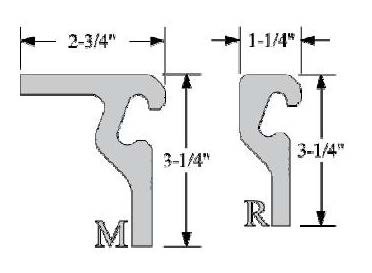
The Watson Bowman Acme product data sheet and D.S. Brown brochure showing the dimensions of each type of extrusion along with other supporting documents, are available at:
https://wbacorp.com/products/
http://www.dsbrown.com/Bridges/ExpansionJointSystems/Steelflex.aspx
KDOT’s Reinforced Concrete Box Culvert Designs for LRFD
Added 1/11/2012 Contact: Bridge Design Manuals, Modeling and Policy Engineer. Phone: 785-368-7175The following information is regarding the release of: LRFD Box Culvert Request Application, Box Design Standards, Bridge Standards BR020B, BR100B and LRFD Manual Section 3.12.
- LRFD culverts are required in projects field checked on or after February 2012.
- Designs are compliant with AASTHO LRFD Bridge Design Manual 2007, 4th Edition, 2009 Interims.
- Designs are load rated LRFR for HL-93 Loading, Load Rating per Manual for Bridge Evaluation 1st Edition, 2010 Interims. The rating factor appears on the plans sheet in the Culvert Summary Block.
- KDOT’s Automated RCB Program is available for both LRFD and LFD designs. KART
- Culverts with 2’-0” or less of design fill (measured at the outside edge of shoulder) are considered "At Grade" boxes. "At Grade" boxes require 100% epoxy coated reinforcement and AE concrete in the top slab of the barrel. The soil side of the top slab and 12” of the exterior wall will be covered with a “Bridge Backwall Protection System” for "At Grade" boxes. This material quantity is calculated, but is subsidiary to other items.
- The wings will remain without epoxy coated reinforcement or AE concrete.
- Fixed structure (RFB’s) are required for all zero-fill culverts.
- The auto-design function of the RCB Request Program (which iterated to find the most conservative design for structures with fill heights less than or equal to five feet) has been turned off.
- All flared wing walls are:
-
- Free-standing
- Granular backfilled for two thirds of the length (nearest the barrel).
- Built with a filter fabric separator between the in-situ material and granular backfill material.
- Built with “Abutment Strip Drain” materials covering weep holes and open joints between wing and barrel. The “Abutment Strip Drain” and Filter Fabric materials are subsidiary to other items.
- Reinforced with 0.87 psf of welded wire fabric placed on the bottom of the wing footings in addition to that required for flexure.
- Apron welded wire fabric has been changed from 0.21 to 0.87 psf to match the material in the bottom of the wing footings.
- Straight Wing walls have not been changed in either design or backfill requirements.
- Standard Drawings BR020B and BR100B are to be used with LRFD designs and BR020A and BR100A with LFD Designs.
- For a more information please see Section 3.12 “Buried Structures and Tunnel Liners” in KDOT’s LRFD Bridge Design Manual Chapter 3
Concrete Bridge Deck Protection
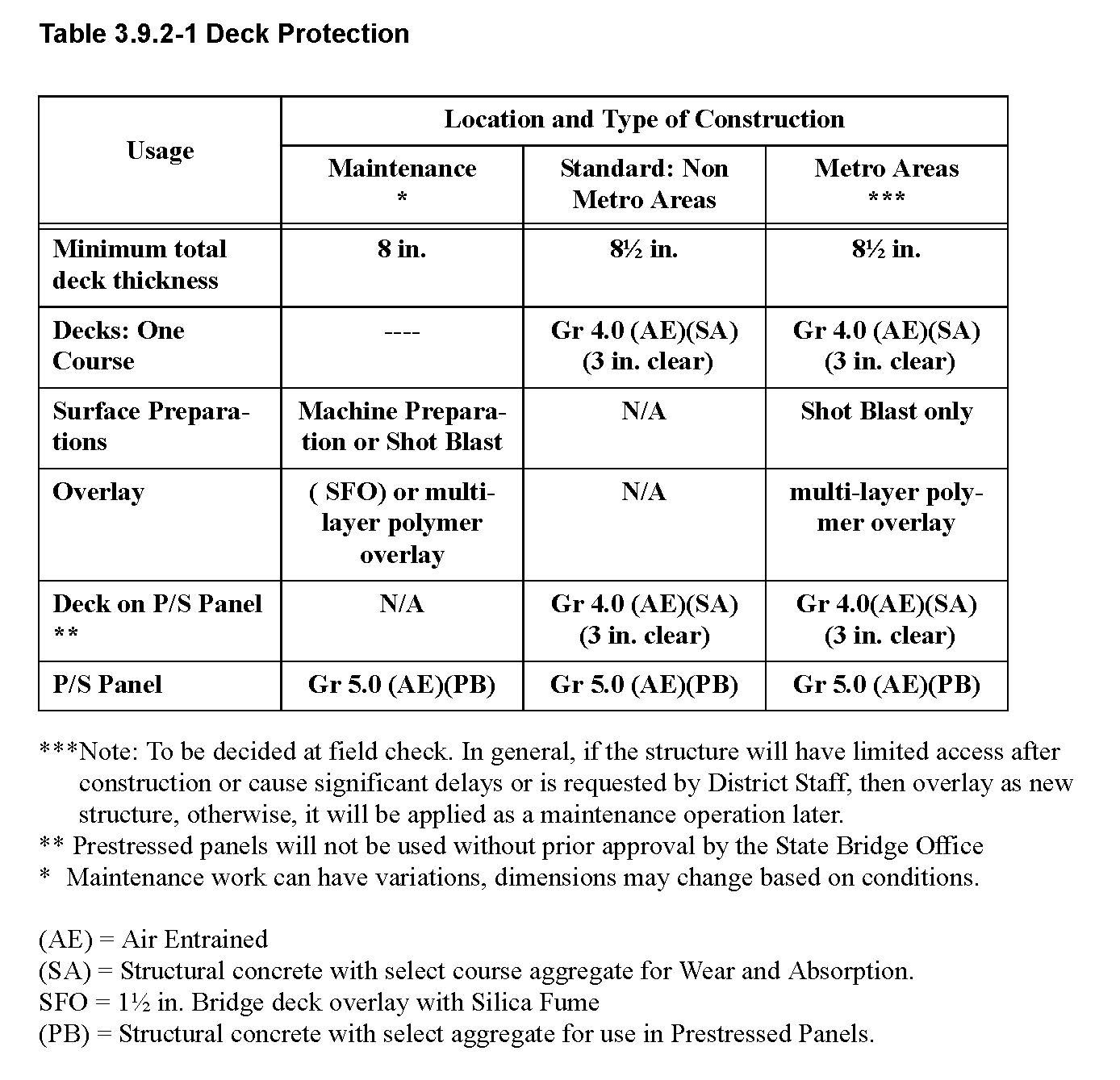
Added 11/28/2011 Contact: Bridge Design Manuals, Modeling and Policy Engineer. Phone: 785-368-7175Modifications to KDOT’s bridge deck protection policy described in KDOT’s LRFD Bridge Design Manual, Section 3.9 have occurred for projects with field checks after (January 2012). The use of polymer overlays have been further clarified based on life cycle cost considerations. The primary adjustment places the use of polymer overlays as a maintenance item to be placed at a later time as determined by KDOT Bridge Management policies, except as shown in the table below.
Concrete Bridge Deck Curing
Added 11/28/2011 Contact: Bridge Design Manuals, Modeling and Policy Engineer. Phone: 785-368-7175Beginning with the March 2012 letting, Special Provision 07-07011-R1 for Concrete Construction describes finishing and curing for all bridge decks. Based on extensive research, rapid curing and extended curing will be required for all projects on the State system. Plastic tining and/or excessive finishing are being replaced by minimal finishing followed by rapid cover with wet burlap (max 15 min.) and diamond tining the grooves after the cure. The bid item “Bridge Deck Grooving”, measured by the square yard, has been created for single course decks without multi-layer polymer overlays. This bid item is not included for bridge decks with polymer overlays or for single course decks on gravel roads, such as on local projects structures. Where the bid item “Bridge Deck Grooving” or “Polymer Overlay” is not included the Contractor will use a coarse burlap drag to roughen the deck.
Ordinary High Water Discharge
Added 10/31/2011 Contact: Bridge Design Manuals, Modeling and Policy Engineer. Phone: 785-368-7175General Note(s) NOT9500 through NOT9530 have been modified to include the Estimated Ordinary High Water Discharge (Qohw). This regulatory flow allows the Contractor to size the pipe(s) opening in compliance with KDOT Landscape Standard LA852B “Temporary Erosion Control”.
The design Engineer will estimate the Qohw based on their determined calculated OHW elevation and detail the flow under the “Drainage Data” note shown on the bridge plans. The OHW elevation and the Qohw are also to be shown in the Hydraulic Assessment Checklist (HAC).
Guidance: The OHW elevation is a physical location indicated by the characteristics of the channel such as a marked change in the absence of growth or vegetation and/or benching of the banks. This is not always obvious for incised channels that lack physical characteristics. For drainage areas < 30 sq. mi. use a Qohw with a 1-year frequency of occurrence.
This supersedes any guidance shown in the KDOT manuals. See the KDOT Survey and Bridge Design Manual for further guidance.
BRIDGE OFFICE STANDARD DRAWING
Added 10/06/2011 Contact: Bridge Design Manuals, Modeling and Policy Engineer. Phone: 785-368-7175Standard Drawing BR031 has changed to include an “Abutment Backwall Protection System” for Precast Box Culverts with fill heights less than or equal to two feet. This material is Subsidiary to other contract items. This Standard Drawing, and two Special Provisions 07-07025 and 07-07017 will begin to be included in projects let January 2012.
BRIDGE OFFICE STANDARD DRAWING AND STANDARD NOTE CHANGE
Added 10/03/2011 Contact: Bridge Design Manuals, Modeling and Policy Engineer. Phone: 785-368-7175General Notes NOT5100, NOT5110 and Standard Drawing BR300A through BR300D have changed to include a camber shipping tolerance for prestressed I-sections. The change incorporates a limit of the design camber + ½” as the maximum limit prior shipping to the site. The design camber is defined as the 50 day camber which is currently being reported on the plans
This change will replace any time limits placed on the prestress manufacture with respect to casting and shipping.
BRIDGE OFFICE STANDARD NOT3510
Added 8/25/2011 Contact: Bridge Design Manuals, Modeling and Policy Engineer. Phone: 785-368-7175General Note 3510 has been modified to describe both the type and size for Rip-Rap Stone and Aggregate Slope Protection. Please refer to Tables 1114-1 and 2 for material types and sizes. The format for the current bid item ‘Slope Protection’ (Section 830) does not lend to both type and size. Past practice was to call out the type and material size on the plan sheets; this will remain the practice along with the additions in the General Note.
NOT3510 SLOPE PROTECTION (Shot Rock): Place Slope Protection (Shot Rock) to the limits and thicknesses shown on the plans or as directed by the Engineer. [Use (type) as described in Section 1114 placed to the limits shown on the plans.]
*** Shot Rock or Rip Rap Stone or Aggregate can be used, fill in the ( ) with the correct type.
*** Designer include sentence in [ ] for Rip-Rap Stone and Aggregate.
*** Designer fill in ( ) with call out from Table 1114-1 for Rip-Rap Stone.
*** Designer fill in ( ) with call out from Table 1114-2 for Aggregate Stone.
EXAMPLES:
SLOPE PROTECTION (Rip-Rap Stone): Place Slope Protection (Rip-Rap Stone) to the limits and thicknesses shown on the plans or as directed by the Engineer. [Use (1/2 ton Heavy Series ) as described in Section 1114 placed to the limits shown on the plans.]
SLOPE PROTECTION (Aggregate): Place Slope Protection (Aggregate) to the limits and thicknesses shown on the plans or as directed by the Engineer. [Use (D50 = 4” ) as described in Section 1114 placed to the limits shown on the plans.]
SLOPE PROTECTION (Shot Rock): Place Slope Protection (Shot Rock) to the limits and thicknesses shown on the plans or as directed by the Engineer.
Addendum to the 2011 LFD Bridge Design Manual Load Rating Section
Added 4/05/2011 Contact: Bridge Design Manuals, Modeling and Policy Engineer. Phone: 785-368-7175An error has occurred causing the reporting of the load posting for the T-3 Load Rating Truck to be shown as 27 tons in two locations within the load rating chapter (#4). A corrected value of 25 tons is shown in the attached *.pdf file. The attached file will be considered an addendum to the 2011 LFD Bridge Design Manual.
AddendumKDOT Prestressed Beam Standard Changes
Added 3/17/2011 Contact: Bridge Design Manuals, Modeling and Policy Engineer. Phone: 785-368-7175The KDOT State Bridge Office has recently made changes to the K2, K3, K4 and K6 Prestressed Beam Sections. These changes allow the substitution of Welded Wire Fabric (WWF) in lieu of the mild reinforcement as shown on Bridge Standards BR302a – BR302d (plans). The mild reinforcement and the WWF are now both non-epoxy coated as shown on BR300a – BR300d, except as noted in bill of reinforcement. For WWF substitution, the wire spacing must be less than or equal to the bar spacing shown on the plans, and the area of steel per foot, for the confinement reinforcement, must be greater than or equal to that shown on the plans.
These changes to the plans are shown highlighted in the attached file. If the reinforcement substitution option is taken by the fabricator, please confirm that the limitations described above are met, and are shown on the shop details.
Note: KDOT will not allow a reduction in the substitution criteria above for using higher yield strength WWF.
Example2011 KDOT LFD Bridge Design Manual
Added 2/23/2011 Contact: Bridge Design Manuals, Modeling and Policy Engineer. Phone: 785-368-7175The 2011 version of the KDOT Bridge Design Manual is available for download. This manual supersedes all previous versions in their entirety. Please review the revisions.
The updated Bridge Design Manual is located on: KART
LRFD Bridge Design Manual
Added 11/8/2010 Contact: Bridge Design Manuals, Modeling and Policy Engineer. Phone: 785-368-7175KDOT has published guidelines, for the protection of structures, to supplement information provided in AASHTO Article 3.6.5.1 Extreme Event II Load: “CT Vehicular Collision Force ” . Please read and incorporate the information contained in Section 3.11, Abutments, Piers and Walls, into future projects. This can be found in KDOT’s LRFD Bridge Design Manual at: http://www.ksdot.org/burDesign/bridge/lrfd/bdlrfdchapter3.asp
Use of Soil Savers
Added 09/13/2010 Contact: Bridge Design Manuals, Modeling and Policy Engineer. Phone: 785-368-7175KDOT's Environmental Services Section has informed the State Bridge Office that KDOT will not receive the required environmental permits when Standard RD520 "Soil Saver" for box culverts is used in areas where aquatic organisms may exist. To eliminate potential project delays, please refrain from using these details on "Bridge Size" structures. Contact the Road Office for projects that involve" Road size" structures. An alternative is being developed. In the mean time, the designer is asked to consider other solutions to minimize the effects of head-cutting or excessive velocities. Where head cutting is anticipated the designer will show a hydraulic easement to the limits of the anticipated material loss.
Note: The permitting agencies may allow exceptions and permit a traditional soil saver if there are existing issues that interrupt aquatic passage such as head-cutting, scour holes, ponds and or lakes. Also early coordination with Environmental Services Section, United States Fish Wildlife Section, and Kansas Department or Wildlife and Parks should be conducted if a traditional soil saver is utilized.
LRFR Rating Table
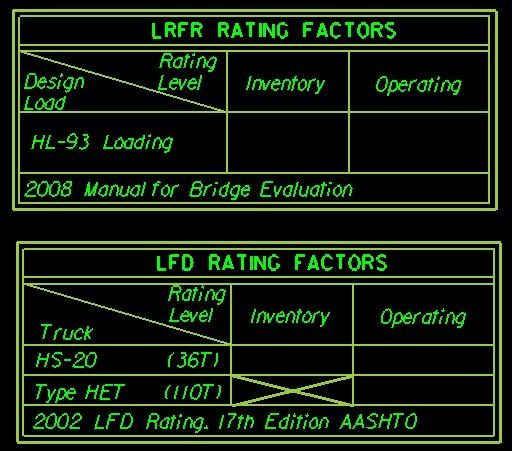
Added 4/29/2010 Contact: Bridge Design Manuals, Modeling and Policy Engineer. Phone: 785-368-7175The Federal Highway Administration is requiring KDOT to report load rating results in LRFR starting in October of this year. As a result, KDOT is requiring that projects let on or after September of this year include both of the following load rating tables. These are new cell's in KDOT's standard cell library. The cell's can be found in our standard cell library and can be down loaded through KART.
2010 LFD Bridge Design Manual Appendix H Revision
Added 02/01/2010 Contact: Bridge Design Manuals, Modeling and Policy Engineer. Phone: 785-368-7175Appendix H: Post Letting Information on Page H-2 labeled “Plan Review Summary Information” has been revised to reflect the Controlled Demolition General Notes and Special Provision. Please update this page in the 2010 LFD Bridge Design Manual. As a reminder, beginning with the March letting, on all projects with open-span bridge removal and/or signing and lighting structure removal, the plans should indicate the demolition category as called out in special provision 07-07014. This includes bridges with partial removal also.
Revised Plan Review Summary2010 Bridge Design Manual Update
Added01/25/2010 Contact: Bridge Design Manuals, Modeling and Policy Engineer. Phone: 785-368-7175The 2010 version of the KDOT Bridge Design Manual is available for download. This manual supersedes all previous versions in their entirety. Please review the revisions.
The updated Bridge Design Manual is located on: KART
Controlled Demolition
Added 12/31/2009 Contact: Bridge Design Manuals, Modeling and Policy Engineer. Phone: 785-368-7175A Controlled Demolition Specification (SP07-07014) will be implemented for projects let beginning March 2010. The three general notes below categorize the plan requirements by demolition complexity and risk to the traveling public. These notes are used on open span structures when removing the entire structure or if portions are removed for repair or rehabilitation. This work is not bid separately, but is subsidiary to the bid Item "Removal of Existing Structure". The bridge designer will verify that this bid item is on the final plans, and determine the category of demolition based on the specification and place the appropriate note on the final plans.
NOT9001 DEMOLITION PLANS: This is a Category A Demolition. Submit detailed Demolition Plans to the Field Engineer per KDOT Specifications. No Demolition work will begin without approved Demolition Plans. A Licensed Professional Engineer is not required.
*** See the Controlled Demolition Special Provision for details and Definitions.
NOT9002 DEMOLITION PLANS: This is a Category B Demolition. Submit detailed Demolition Plans to the Field Engineer at least 2 weeks before the demolition meeting. Identify, on the plans, the Demolition Supervisor meeting the requirements of the KDOT Specifications. No Demolition work will begin without approved Demolition Plans. A Licensed Professional Engineer is not required.
*** See the Controlled Demolition Special Provision for details and Definitions
NOT9003 DEMOLITION PLANS: This is a Category C Demolition. Submit detailed Demolition Plans to the State Bridge Office (or Bureau of Local Projects) at least 4 weeks before beginning the demolition process. Portions of the submitted details shall bear the seal of a Licensed Professional Engineer. Identify, on the plans, the Demolition Supervisor meeting the requirements of the KDOT Specifications. The Demolition Supervisor will attend the required pre-demolition meeting before these operations begin, as described in KDOT Specifications. No demolition work will begin without approved Demolition Plans.
*** See the Controlled Demolition Special Provision for details and Definitions
LRFD Bridge Design Manual
Added 09/11/2009 Contact: Bridge Design Manuals, Modeling and Policy Engineer. Phone: 785-368-7175KDOT has added two sections to the LRFD KDOT Bridge Design Manual, Section 3.5.1 ”Concrete Structures” and Section 3.5.2” Prestressed Concrete”. Please refer to these sections as they supersede the 2009 LFD Bridge Design Manual sections.
Manual is available for use at: http://www.ksdot.org/burDesign/bridge/lrfd/bdlrfdchapter3.asp
BRIDGE OFFICE STANDARD NOTES NOT1005, NOT9301
Added 07/2009 Contact: Bridge Design Manuals, Modeling and Policy Engineer. Phone: 785-368-7175The following Bridge Office Standard Notes (USC) were Modified for LRFD foundation designs.
NOT1005 PILING: Drive all piling to [penetrate or bear upon the ___________ formation](or)[a minimum elevation of _______]. Driving shall stop when in the opinion of the Engineer additional driving may damage the piling. Drive all piling to the Pile Driving Formula Load of:
| Abutment No. 1 | ______ | Tons |
| Pier No. 1 | ______ | Tons |
| Pier No. 2 | ______ | Tons |
| Abutment No. 2 | ______ | Tons |
As a minimum drive each pile to the load and penetration, but in no case shall the pile be driven to more than 110% of Pile Driving Formula Driving Load. At any location where problems are experienced, pile damage is suspected, or the Pile Driving Formula Load occurs significantly above the design pile tip elevation, the Engineer may request that the Pile Driving Analyzer (PDA) equipment be used.
*** The Designer will fill in the above ________ with the formation or elevation as provided in the geology report.
*** The Designer will fill in the above ________ in Tons with the Strength I Limit State.
*** The Pile Driving Formula Load is the value calculated from the pile formulas in the Specifications.
***When the PDA is used, the piles are driven to a Strength I /Phi resistance value.
NOT9301 LRFD DESIGN PILE LOAD:
| Design Loading (Tons/Pile) | Strength | Service | Phi |
| Abutment | ______ | ______ | ______ |
| Piers | ______ | ______ | ______ |
*** The designer will fill in the ____ above for the controlling limit state. The value of Phi is in the Geology Report.
KDOT LRFD PILE FOUNDATION INFORMATION
Added 07/2009 Contact: Bridge Design Manuals, Modeling and Policy Engineer. Phone: 785-368-7175The bridge designer will review the geology report and choose the pile size that gives an appropriate number of piles for the application intended. For example, a pile cap may have an odd or even number of piles arranged in a symmetric manner. For a structure being built using phased construction the designer will determine the number of piles appropriate for the phasing layout.
The geology report will have a table of capacities and resistance factors for each bent and pile sizes as show below. Any special instructions such as pre-drilling, pile points, re-strike and the use of the PDA will be indicated and included in the final plans.
| Location | Centerline Station | Elevation Top of Bedrock | Pile Tip Elevation | |||||
|---|---|---|---|---|---|---|---|---|
| 10 x 42 | 12 x 53 | 12 x 74 | 14 x 73 | 14 x 89 | ||||
| Abutment 1 | 580+15.28 | 907.4 | 894.0 | 892.0 | 892.0 | 892.0 | 892.0 | |
LRFD Design
Resistance and Phi Factor Information for Abutment 1
| Pile HP 10 x 42 | Pile HP 12 x 53 | Pile HP 12 x 74 | Pile HP 14 x 73 | Pile HP 14 x 89 | |
|---|---|---|---|---|---|
| Rn (kips) | 320 | 403 | 566 | 558 | 683 |
| Rr (kips) | 208 | 262 | 368 | 363 | 444 |
| Phi Factor | 0.65 | 0.65 | 0.65 | 0.65 | 0.65 |
Using the Information above:
Example:
Total Strength I Reaction at Abutment #1 = 1,650 kips Try HP12 x 53
The Service I Reaction at Abutment #1 = 968 kips
The number of Piles reqr'd = Pu / Rr = 1650 kip / 262 kip per pile = 6.29 pile (OK), use 7 piles
The Strength I Load per pile = 1650 kip / 7 piles = 235.7 kip per pile
The Service I Load per pile = 968 kip/ 7 piles = 138.3 kip per pile
Use General Notes: NOT1005 and 9301
NOT1005 shown incomplete for example purposes
PILING: Drive all piling to penetrate or bear upon the Lane Formation. Driving shall stop when in the opinion of the Engineer additional driving may damage the piling. Drive all piling to the Pile Driving Formula Load of:
| Abutment No. 1 | 118 | Tons |
| Pier No. 1 | ___ | Tons |
Designer notes below are included in the plan notes, but not placed on the plans
*** The Designer will fill in the above ________ with the formation or elevation as provided in the geology report.
***When the PDA is used, the piles are driven to a Strength/Phi resistance value.
*** The Pile Driving Formula Load is the value calculated from the pile formulas in the Specifications.
NOTE:
The Controlling Strength Limit is used because the Modified ENR Pile Driving Formulas used by KDOT have a Factor of Safety between 5.0 – 8.0 built into them, and have not been calibrated to the Nominal Resistance from the PDA driving RPDA. When the PDA is used in the field and the blow count is established for a particular hammer the Nominal Resistance, Rn = Strength/Phi resistance value is used because the PDA has no built in Factors of Safety but, measures the actual forces and stresses. When the PDA is used the minimum driving resistance is RPDA, and the maximum driving force is 110% RPDA.
NOT9301 shown incomplete for example purposes
LRFD DESIGN PILE LOAD:
| Design Loading (Tons/Pile) | Strength I | Service I | Phi |
| Abutment 1 | 118 tons | 69 tons | 0.65 |
| Piers | _________ | _________ | ________ |
*** The designer will fill in the ____ above for the controlling limit state. The value of Phi is in the Geology Report.
NOTE:
The information above clarifies the service conditions and reports the Strength Limit State, when the PDA is used the Nominal Resistance can be calculated by the Geologist.
The PDA requested on the Geology Report accompanies the bid item, "Test Pile Special", and designer will add an additional 5'-0" to the pile length to allow for the gages to be installed.
Pile Splice Criteria (BR110)
Added 06/5/2009 Contact: Bridge Design Manuals, Modeling and Policy Engineer. Phone: 785-368-7175Special Assignments has updated the Pile Standard BR110 and added a new Standard Note (NOT1003). These changes are meant to keep pile splices out of high-flexural regions on integral bents. The changes allow some leniency for the Contractor to provide a work-around with minimum expense and still not compromise the bent.
- The Contractor is allowed one splice per bent in the high-flexure region without penalty. The Contractor does not have to NDT that splice.
- All other splices in that bent in high-flexure regions must be welded and NDT. High flexure regions are those identified in BR110.
- The Bridge Designer is required to use NOT1003 to identify which supports are considered integral abutments and integral piers.
Hopefully the first splice located in a high-flexure region (without penalty) will encourage the Contractor to splice on extra length and drive the piling such that the splice is as deep as possible. Reviewing the new note and the changes to the standard may explain the goals more clearly.
Approach Expansion Joints
Added 05/27/2009 Contact: Bridge Design Manuals, Modeling and Policy Engineer. Phone: 785-368-7175After field review and comments from the KDOT District forces, the Road and Bridge Design Sections have eliminated the Type ”B” two part silicone and the Type “C” preformed elastomeric neoprene expansion joints. A membrane sealant will be used for all joint locations “W” shown on the Road Standard RD712 for the 13’ approach slab, there is an accompanying Special Provision for this new joint type. (Polytite is currently used although other membrane sealants may meet the requirements of the Special provision.) The Road Design Section has also elected to use a membrane sealant at the pressure relief joint location (at the end of the 20’ approach slab). This joint has a range of applicability for steel structures of 380’ (length of expansion), and for concrete structures of 410’ (length of expansion). A reduction for the skew effects of 4% for every 10 degrees of skew will be used. The 2010 LFD Bridge Design Manual will be updated to reflect these changes.
The attached RD712 can be used now however, because it is a FHWA standard, line thru the number RD712 until it is formally approved for use by FHWA.

2009 Bridge Design Manual Update
Added 02/04/2009 Contact: Bridge Design Manuals, Modeling and Policy Engineer. Phone: 785-368-7175The 2009 version of the KDOT Bridge Design Manual is available for download. This manual supersedes all previous versions in their entirety. Please review the revisions, summary and development preface on pages R-1 and R-2.
The updated Bridge Design Manual is located here: KART
KDOT Prestressed Bridge Design
Added 12/21/2009 Contact: Bridge Design Manuals, Modeling and Policy Engineer. Phone: 785-368-7175KDOT policy has changed for the design of prestressed bridges in response to current AASTHO LRFD Specifications. These changes are discussed in more detail within Section 3.5.2 of the KDOT LRFD Bridge Design Manual that will be released in November.
The available documents include:
- A summary of LFD Rating and LRFD Design values
- A summary of design philosophy and requirements
- BR305 is a base sheet created to guide designers in the consistent use of temporary diaphragms
HET Loads
Added 09/08/2008 Contact: Bridge Design Manuals, Modeling and Policy Engineer. Phone: 785-368-7175Historically, new bridge designs near Ft. Riley's Military Base were designed such that load rating at the operating level (LFD) with the Heavy Equipment Transport Load (HET) resulted in a rating factor of 1.0 or greater. Recently, KDOT's Bridge Management Section has noticed that routing of this HET is not limited to the region mentioned, but covers the entire state of Kansas. Therefore, all new open span highway bridge structures (located on State Highway System) will be designed to load rate as stated above.
The previously delineated HET area now contains more stringent seismic detailing criteria per Section 3.3.4.8.
See the Bridge LRFD Manual Section 3.3 Loads and Load Factors
Reinforced Concrete Box Request Form (Web Application)
Added 09/09/2008 Contact: Bridge Design Manuals, Modeling and Policy Engineer. Phone: 785-368-7175There is a new online web application found on the KART site to use in lieu of the old RCB Request pdf form. The new request application provides these benefits:
- It validates the input entered
- It limits requests to available box standards
- It calculates an online quantity/detail/cost summary before submitting to KDOT for MicroStation dgn CAD creation (Alternatives can be better evaluated before requesting detail files. Costs are based on a fixed set of cost data and will not reflect changing material prices.)
- It creates the input file used with the internal windows RCB program and attaches itself to the request email sent to KDOT
Traffic Data Table
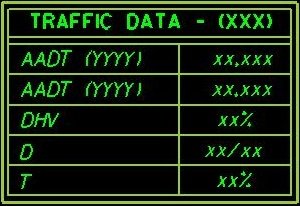
Added 09/09/2008 Contact: Bridge Design Manuals, Modeling and Policy Engineer. Phone: 785-368-7175Include the cell below for each span structure on projects where the "Title Sheet" traffic data is intended to be applied to more than one structure. This is a new cell in KDOT's standard cell library. This cell can be found in our standard cell library which can be down loaded through KART
Revised LRFD BDM Section 3.3 Loads and Load Factors
Added 09/09/2008 Contact: Bridge Design Manuals, Modeling and Policy Engineer. Phone: 785-368-7175This section includes information on the seismic detailing of columns within the Ft. Riley influence region and includes guidelines addressing vehicular impact.